
Getting Found on Google and ChatGPT: My Method.
In my last blog, I talked about the benefits of getting found on Google + ChatGPT as an alternative to performing for social media.
This blog is about how I get found. My process.
The TLDR? Doing SEO isn’t that techy.

Talking about the benefits of being found on Google and ChatGPT is one thing.
Understanding how to make it happen is another.
A few years ago, I ran a little experiment in my business:
How can I make marketing feel easier?
I realised something very quickly. I much prefer it when people find me.
So I made an intentional decision to redirect my weekly 3 hour marketing slot away from social media… and towards SEO.
A decision I am delighted with.
Because now, most of my business comes from search. Before this, it was largely referrals + yes, Instagram.
But before I get into my process, I need to give you some context.
Because I don’t think it’s easy to follow said process unless your business is prepped for getting found in the first place.
Niching: a reframe
Over the past few years, I shifted my business from general Online Business Management to focusing on a specific area: systems. Primarily tech setups in Kajabi and Moxie CRM.
However, I still offer lots of services outside Kajabi + Moxie. As I write this, I’ve just wrapped up:
a Mailchimp makeover
a domain switch over
a Flodesk funnel project
I just don’t talk heavily about this type of work in my marketing.
Niching does not mean you box yourself in.
As a multi-passionate (natural generalist), I really struggled with this.
Niching for marketing purposes means you become known for something, which makes getting found through search so much easier (and referrals by the way.)
It’s less about picking a narrow industry, and more about being laser focused on who you help and what problems they actually have.
So the real question is:
What do you want to be found for?
My long love affair with SEO
We think SEO is super techy and complicated. But I’ve always known different.
Back in 2016, I started a wedding cake business called Rebel Cakes. I set my entire website up to rank for one thing:
“Wedding Cakes York.”
Yes, I reverse engineered the whole thing and almost all my business came from search.
Did I post cake photos on Instagram? Sure. It was a very useful touchpoint. But with a newborn hanging off my nip, I didn’t have time for high energy marketing.
So this strategy alongside befriending local cake makers for a lovely referral loop, was my low effort marketing sweet spot.
Fast forward to this business. A few years in, exhausted by the social media hamster wheel, I set about recreating that success.

Getting found on ChatGPT is about association
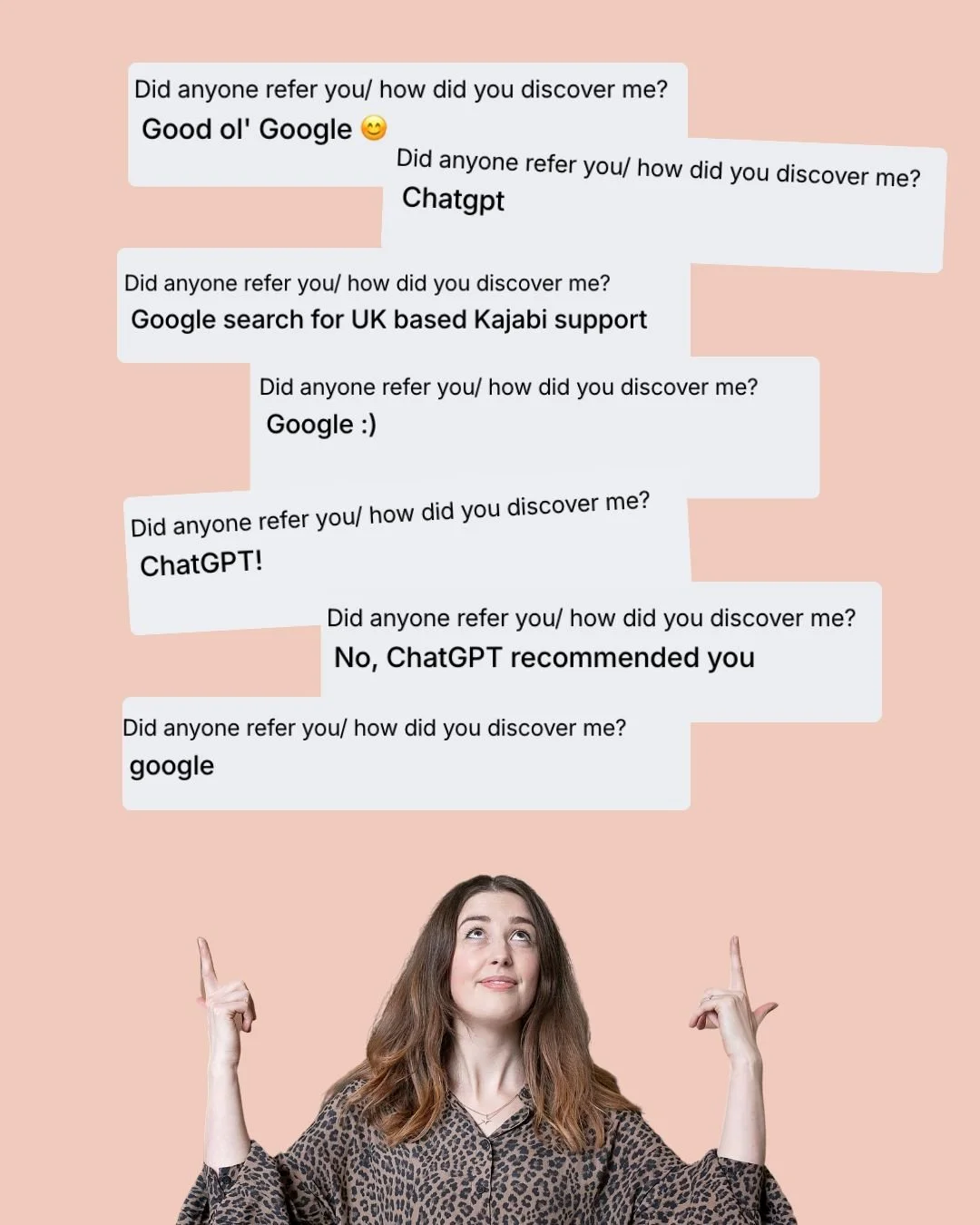
When someone asks ChatGPT or Google a question, they’re looking for solutions.
If your name is repeatedly associated with that thing in clear, structured ways online - coupled with excellent ‘that’s person sees me’ copy, you become an obvious match.
That’s what’s happening when I appear in search results and AI recommendations.
I’m not being chosen at random. I’m being matched based on patterns.
My name is consistently connected to Kajabi + Moxie, and that connection is visible across my digital footprint.
SEO: Speaking the Right Language
I don’t run ads, blog every week (yet) and I haven’t hired an SEO agency for thousands of pounds.
I just follow the same simple process every time I publish a page.
Before I create a page, I ask:
What are people actually typing when they’re looking for this help?
Sometimes that’s not the title I’d naturally choose.
For example, I optimised sales pages around “Kajabi VA.” Not because that’s the job title I’d use, but because that’s what people search when they want someone to make Kajabi work.
Getting found starts with speaking the language of the person searching, not the language of your own industry.
Be clear, not clever, where it matters.
So where does it matter? Read on.
My very unglamorous SEO process
Every time I publish a page, I run through the same mental checklist.
First, I decide the key search term - ideally something with good search volume and lower competition. Tools like Ubersuggest help tell you this, but even Google’s suggested searches tell you a lot.
Then I make sure that term (and natural variations) appear in key structural places:
The URL
The main H1 headline (only 1 every per page)
The SEO page title + meta description (under 140 characters)
Subheadings (H2s, H3s, H4s etc)
The body copy (1-2 times every 500 words rule of thumb)
Image file names and alt text
This isn’t about keyword stuffing - write human always.
It’s about being clear and consistent about what the page is actually about.
I also link out to high authority sites when relevant. If I’m writing about Kajabi, I’ll link to a Kajabi help article. That places my content in the wider ecosystem of trusted information.
Once the page is live, I use the URL Inspection tool in Google Search Console so it gets crawled. I don’t just publish and hope. I nudge Google to come look.
That’s it. That’s my whole process.

how SEO tactics work with tools like ChatGPT
Tools like ChatGPT don’t invent recommendations out of thin air. They reflect patterns in publicly available information.
If your name:
appears repeatedly alongside certain tools or roles
is connected to clear explanations of what you do
is referenced in context with other trusted sources
…you become a logical suggestion when someone describes that problem.
It helps that my website is my name.
That creates a strong, consistent signal. But the real driver is clarity. I’m not vague about what I help with.
When someone types a long, detailed question into ChatGPT about Kajabi, Moxie, or needing tech systems support, I’m already part of that landscape online. So I surface.
Think nobody is Googling you?!
‘But nobody is searching for my type of service’
Maybe you’re not a “plumber near me” or a Kajabi expert like me.
That doesn’t mean people aren’t searching for answers to their problems.
They might not type directly into ChatGPT: “I need a leadership coach.”
But they might type: “How to have difficult conversations at work” “How to motivate my team”
Your long form content can meet them there.
If someone says it’s impossible to get clients without social media, they’re often describing a lack of infrastructure elsewhere, or a very linear view of marketing.
If people are searching for help — and they are — you can be found.
Sometimes we just need to be a little more creative.
Being found is built on clarity
The clearer you are about what you do and who it’s for, the easier it is for search engines (and tools like ChatGPT) to connect you with the people already looking for exactly that.
Meeting someone at the moment they’re already looking for help is far easier than trying to persuade of the need in the first place.
Expert advice for Getting found on Google + ChatGPT.
Look, I am no SEO expert, and I don’t offer this as a service.
But I am a business owner who gets found on Google and ChatGPT. And I’ve made that happen in more than one business by:
Positioning myself with clear keyword association
Following a simple SEO checklist every time I publish
I recognise we should listen to the most legitimate authorities on topics, competence and congruence is important to me so… I’ve invited an actual SEO expert Maddy Shine to add her thoughts to this conversation.
Words from SEO Expert Maddy Shine:
“I love that Charlotte wrote this piece from her personal experience because there’s a lot of noise out there about how to get found on ChatGPT.
People come to me panicking that they have to throw their (usually old or non-existent) SEO strategy out the window now that AI is here. I’ve been supporting people with SEO for 14 years so I’ve seen the trends come and go! (No Barbara, no one is planning their wedding through Alexa).”
”But, being focused on a niche is absolutely fantastic for being found. Talking about that niche with words (not just pretty pictures) in different places around the internet is key whether that’s on your website, your blog, mentions on other websites, directories, press features - all of it adds to context. And context is absolutely key to being found.”
“And yes, if you’re selling multiple services, great!
But you can only talk about one of them at a time because it’s important to be clear”.
”We’re not just doing to feed the Google monster, or the ChatGPT monster, we’re doing it to show people who might actually book us if they could only see us…
…Context + clarity = getting found and booked.”
If you’d like expert support, you can check out Maddy’s SEO services here: sassyandsoft.co.uk or go follow her on Instagram here: https://www.instagram.com/maddy.shine/

My SEO challenge to you
Bookmark this page.
Ask yourself: What do I want to be found for?
Revise one service page. Follow this checklist. See what happens in a few days..
Over time, you can stop chasing attention and start being found when someone is already looking for exactly what you offer.
Charlotte x
For thoughtful service providers who don’t want to live inside social media, getting found is a far more energetically sustainable way to market.
If that’s you (hello, fellow rebel), come join me in a more intimate space, my email list.
Join The Goss now (yes, I married him for the surname.)